We get called about "the chimney leaking" constantly. The chimney is rarely the leak — it is the location. Here is where the water is actually coming in, ordered by how often we find each one.
1. Flashing (by a wide margin)
Flashing is the metal that seals the joint where the chimney passes through the roof. Done correctly it is two pieces: step flashing woven into the shingle courses, and counter-flashing cut into a mortar joint and folded over the step flashing.
Done incorrectly — which is most of the time — it is one piece and a tube of roofing tar. Tar has a service life of a few years, then it cracks, and the leak returns. If someone has "fixed" your chimney leak twice already with a caulk gun, this is why.
2. The crown
The concrete slab on top should extend past the brick by about two inches with a drip edge, slope away from the flue, and have an expansion joint where it meets the tile. Most crowns around here have none of that. They crack, and every rainstorm pours water into the top of the masonry. See crown repair.
3. Missing or failed cap
An uncapped flue is an open pipe pointed at the sky. A moderate rainstorm can put a surprising volume of water directly into your firebox, damper and smoke shelf. A stainless cap is a few hundred dollars and prevents thousands in damage. It is the best-value item on the entire chimney.
4. Porous brick and open mortar joints
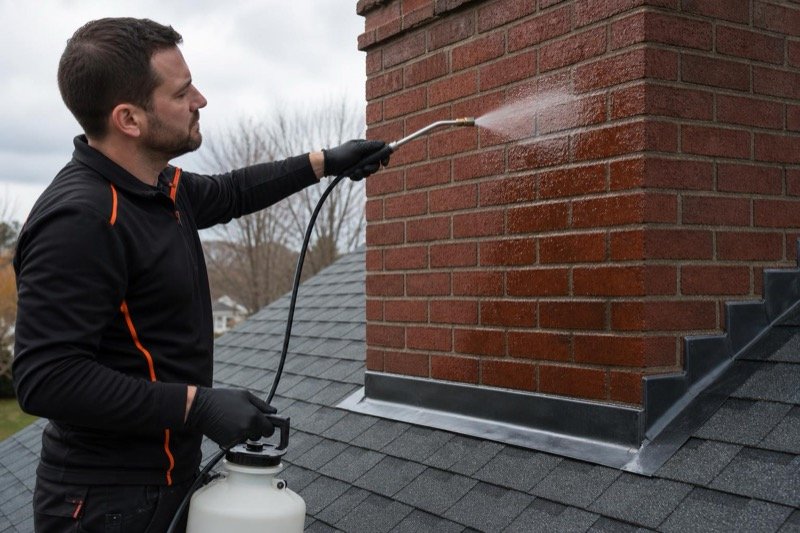
Brick is a sponge. That is not a defect — masonry is designed to absorb some water and release it. But once mortar joints have receded and brick faces have spalled, absorption outpaces drying and water reaches the interior. This is where breathable waterproofing earns its keep.
Critical detail: the sealer must be vapor-permeable — a siloxane or silane. Film-forming sealers, including most hardware-store "waterproofers" and anything silicone-based, trap moisture inside the brick. The next hard freeze then pops the faces off from the inside. We have replaced a lot of brick that a DIY sealer destroyed.
5. Condensation (the sneaky one)
Sometimes there is no leak at all. A high-efficiency furnace vented into an oversized masonry flue produces cool, acidic exhaust that condenses inside the chimney and soaks the masonry from within. The fix is not sealing — it is a correctly sized liner.
How we find it
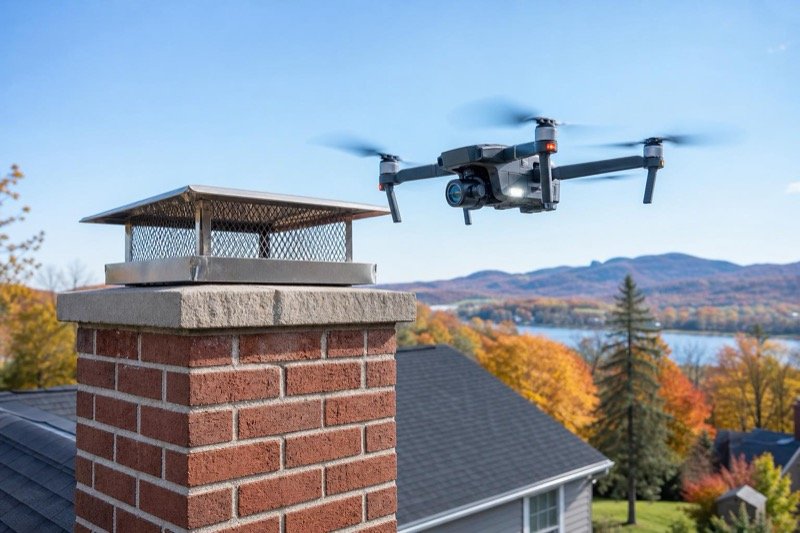
Roof-level inspection with photos of every face, crown and flashing detail, plus an interior look at where the stain appears and how it moves. Water tracks along framing before it drops, so the stain location is a clue, not an answer.
Do not wait on a leak
Water intrusion is the start of nearly every expensive chimney repair. Freeze-thaw turns a hairline crack into spalled brick, spalled brick into failed mortar, failed mortar into a rebuild. A $600 crown repair in September is a $5,000 rebuild in four winters.
Want us to take a look?
Free estimates across all 97 towns we serve. We will tell you honestly if nothing needs doing.