
The expensive chimney repairs we do almost always started as a cheap one somebody drove past for six years. Here is what to look for, in rough order of how often it turns up.
1. White chalky staining on the brick
Called efflorescence. It is mineral salt left behind when water moves through masonry and evaporates. It is not itself damage — it is proof of water intrusion, which is the thing that causes damage. Where you see it, water is moving through the brick.
2. Brick faces flaking or popping off
Spalling. Water gets absorbed into the brick, freezes, expands roughly nine percent, and blows the face off. Once the face is gone, the softer interior absorbs water even faster. This accelerates — it does not hold steady.
3. Mortar joints you can scratch out with a key
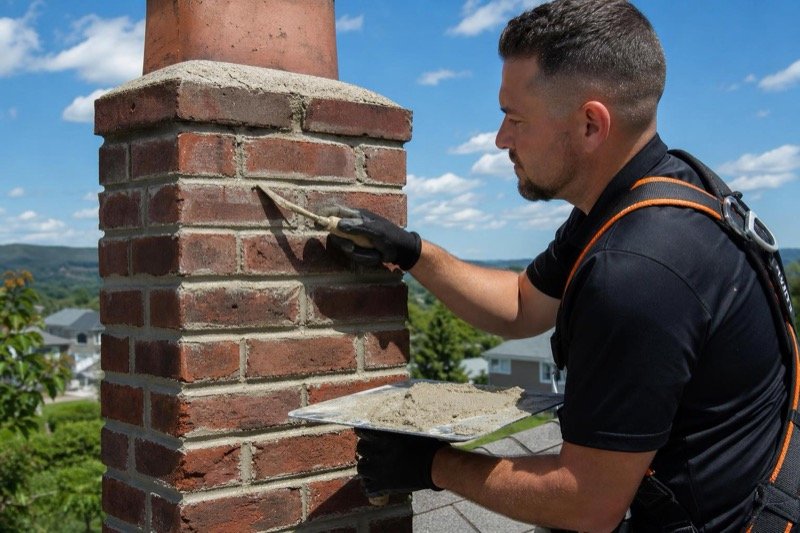
Mortar is sacrificial by design; it is meant to be softer than the brick so it fails first. When joints recede more than about a quarter inch, water has a direct path into the core of the chimney. This is repointing territory, and it is cheap compared to what comes next.
4. A cracked crown
The crown is the concrete slab on top. Most in this area were poured thin and flush with the brick, with no overhang and no expansion joint — so they crack within about a decade and funnel water straight down into the chimney. Crown repair is one of the highest-value fixes there is.
5. Rust on the damper or firebox
Steel inside a chimney does not rust from humidity. It rusts because water is coming down the flue, which means a missing or failed cap, a cracked crown, or both.
6. Ceiling or wall stains near the chimney
Usually flashing, occasionally crown. Note that the stain often appears several feet from the actual entry point, because water tracks along framing before it drops. This is why guessing at leaks fails and systematic diagnosis works.
7. Tile shards in the firebox
If you find curved pieces of terracotta on the smoke shelf, your clay liner is failing. Stop using the fireplace. A compromised liner means fire and carbon monoxide have a path to the framing. This is relining, and it is urgent.
8. A strong campfire or tar smell, especially in summer
Creosote absorbs humidity and gets loud about it. It usually means heavy buildup, poor draft, or both. The smell is a symptom; the fire load is the problem.
9. Smoke coming into the room
Could be a blocked flue, an unparged smoke chamber, a damper not opening fully, or a house too airtight to feed the fire. Each has a different fix — see our page on fireplace repair.
10. A visible lean or gap
A chimney separating from the house, or leaning off vertical, is a structural matter, not a cosmetic one. Do not use it, and get a rebuild assessment.
11. Animal noises
Scratching, chirping or flapping means a nest, and a nest means a blocked flue and a fire load. Removal, cleanout and a cap — in that order, or it happens again next spring.
Which ones mean stop today
Tile shards, a visible lean, smoke or CO alarms during a fire, or evidence of a past chimney fire. Everything else can wait for an appointment. Those four cannot.
Want us to take a look?
Free estimates across all 97 towns we serve. We will tell you honestly if nothing needs doing.